Two Mountains
For ye are not come unto the mount that might be touched, and that burned with fire, nor unto blackness, and darkness, and tempest, And the sound of a trumpet, and the voice of words; which voice they that heard intreated that the word should not be spoken to them any more: (For they could not endure that which was commanded, And if so much as a beast touch the mountain, it shall be stoned, or thrust through with a dart: And so terrible was the sight, that Moses said, I exceedingly fear and quake:) But ye are come unto mount Sion, and unto the city of the living God, the heavenly Jerusalem, and to an innumerable company of angels, To the general assembly and church of the firstborn, which are written in heaven, and to God the Judge of all, and to the spirits of just men made perfect, And to Jesus the mediator of the new covenant, and to the blood of sprinkling, that speaketh better things than that of Abel.
Hebrews 12:18–24
When we arrive at verse 18, we come to that first word “for”. We are being connected to something that comes before, and as we are connected, we should observe to what we are connected.
That which comes before immediately is the guarding against those that would defile the congregation — the root of bitterness that would and could spring up among them. Those of their own, as was the root that Moses warned of in Deuteronomy 29:18, “a root that beareth gall and wormwood”.
This root would be one that would turn away the people from the LORD, and from His covenant with them. He would turn them to idols and to the gods of the nations around them. Under consideration here, if one were to do that in either our present, or the present that the recipients of this epistle were in, it would be as anathema as it was when Moses first said it.
But that is not what we see as the problem among the Israelites either at the time of Christ or afterward. In the end of Romans 9 and the beginning of chapter 10, we have the following:
“But Israel, which followed after the law of righteousness, hath not attained to the law of righteousness. Wherefore? Because they sought it not by faith, but as it were by the works of the law” (Romans 9:31–32). Further, in chapter 10, we read that “they being ignorant of God’s righteousness, and going about to establish their own righteousness, have not submitted themselves unto the righteousness of God. For Christ is the end of the law for righteousness to everyone that believeth” (Romans 10:3–4).
I will speak particularly regarding some Jewish Christians now, and it would not be only about them. There are many others as well, who have a tendency to go back to Sinai, back to Moses, and back to the Law, or Torah. But that would be a root of bitterness that would cause them to walk in the wrong direction. That is where we begin at verse 18. We start by saying where we are not to arrive.
“For ye are not come”
In verses 18-21, we have the description from the books of the law, or the Torah, of Mount Sinai as analogous of the giving of the Law as to what the law was to the people who heard it and who lived under it.
We start here with “the mount that might be touched”. It was surely possible to touch the mount that we know as Mount Sinai. We know Mount Sinai as a real geographical place and not just a myth of a far-off land in another world. We can find the Sinai Peninsula on a map and while there may be questions as to which exact mountain it was, it is still there. Furthermore, we can see that while it “might be touched”, we read in just two verses later that it was fatal to do so, at the time when Moses received the Law. In Exodus 19 before Moses received the Law, we read the commandment meant for the people to guard themselves:
Exodus 19:10–13 — “And the LORD said unto Moses, Go unto the people, and sanctify them to day and to morrow, and let them wash their clothes, And be ready against the third day: for the third day the LORD will come down in the sight of all the people upon mount Sinai. And thou shalt set bounds unto the people round about, saying, Take heed to yourselves, that ye go not up into the mount, or touch the border of it: whosoever toucheth the mount shall be surely put to death: There shall not an hand touch it, but he shall surely be stoned, or shot through; whether it be beast or man, it shall not live: when the trumpet soundeth long, they shall come up to the mount.”
Very clear — this is not some vision or ethereal dream. This was God coming down in the presence of the people where they could all see Him. It was to a mountain that they could physically touch. But there was a warning: DON’T!
Now we must be clear that the same God that gave the words at Sinai is the One that speaks to us now. But to Sinai is not where we are come. In the opening verses of this epistle, the words are that God, “hath in these last days spoken unto us by His Son”. He spoke with thunder and lightning as their fathers in time past heard and feared. That is not how He is speaking to them now, but to be sure, this same voice that shook the earth made a promise that “yet once more I shake not the earth only, but also heaven” (vs. 26, Haggai 2:6).
But we must remember that this starts with “for ye are not come”. The Hebrews that received this and all of us, now, that read this must remember that this is not the destination that we have arrived at. We are not arriving and have not arrived at the fearful Mount Sinai. We are not commanded back to Mount Sinai. We are not called to once again correct our paths to observe the Law that was given as the covenant to Moses. That was the way that the Israelites in time past were to relate to the LORD. We read this at the beginning of chapter 10:
“For the law having a shadow of good things to come, and not the very image of the things, can never with those sacrifices which they offered year by year continually make the comers thereunto perfect.”
This should always be a reminder of what the law was and it brings us back to the Apostle’s words in Romans 8:3 as well:
“For what the law could not do…”
A desire to go back to the law brings us back to a yoke that the Apostle Peter knew and claimed that “neither our fathers nor we were able to bear” (Acts 15:10). This was about not bringing the Gentiles that believed under the yoke or the burden of the Law. We now read in the Epistle to the Hebrews that they are not to go back under it either. “For ye are not come!”
While the law at its giving showed the overwhelming and all-powerfulness of God, coupled with His holiness and righteousness, it did not bid “come”. It commanded “stay back or die!” The witness of Scripture as the history of the people under the law played out was the conclusion that Paul gives to us in his epistle to the Romans as the final verdict is written:
“There is none righteous, no, not one” (Romans 3:10).
The conclusion of the Law is in Romans 3:19-20:
“Now we know that what things soever the law saith, it saith to them that are under the law: that every mouth may be stopped and that all the world may become guilty before God. Therefore by the deeds of the law there shall no flesh be justified in His sight: for by the law is the knowledge of sin.”
It is wonderful and glory to know that this mountain is not where we, or they, are come. We are not come to Mount Sinai to relate to God. In this entire epistle to the Hebrews, we read of that covenant being made old and ready to vanish. God has replaced it with something better — by a new and living way (vs. 10:20). The worship under the Law is done away by this that is truly better. The relation under the law is done away by this that is better.
“But ye are come”
We are now told that we are come to a better mount. Look at these wonderful words of where we are come, before we talk about them individually:
- The city of the living God
- The heavenly Jerusalem
- An innumerable company of angels
- The general assembly and church of the firstborn which are written in heaven
- God the judge of all
- The spirits of just men made perfect
- To Jesus the mediator of the new covenant
- The blood of sprinkling that speaks better things
The mount that the Scripture says we are come to is Mount Sion, or as we would see if we open our Old Testaments, to Mount Zion. This does give us cause to reflect on what Zion is scripturally. In this verse it says “ye ARE come”. That is present tense. How are we come, or they even that first received this epistle, come right now in the present to Mount Zion?
The answer is in how it is further described. At risk of jumping into the weeds of theological controversy, this passage is a touchstone of it. On a popular level, those of the Covenant Theology leaning will say things that would be summarized that this is a slam dunk against those of the Dispensational Theology leaning. Why? Because it is very clear from this that this Mount Zion is not a present place on earth or Jerusalem as we see it now or as they would have saw it then. It is the city of the living God and heavenly. We see in Galatians that same thing where Paul speaks of Jerusalem which is above (Galatians 4:26), clearly contrasted with the Jerusalem that is on earth. Covenant theology speaks of the New Testament and Paul especially “transforming” the things in the Old Testament, the prophets especially, into new heavenly things that are very different from what prophets and the people that they were speaking to would have understood.
This is an example of that and we have to acknowledge that we do see this here. Yet when we look in the Prophets, the Psalms, etc., we see Zion as being on earth without indication of it being heaven at all. If you open to any page in the Psalms, you will likely see references made to Zion. Isaiah chapter 2 is what comes to my mind most when considering Zion as used in the Old Testament:
Isaiah 2:1–5 — “The word that Isaiah the son of Amoz saw concerning Judah and Jerusalem. And it shall come to pass in the last days, that the mountain of the LORD’S house shall be established in the top of the mountains, and shall be exalted above the hills; and all nations shall flow unto it. And many people shall go and say, Come ye, and let us go up to the mountain of the LORD, to the house of the God of Jacob; and he will teach us of his ways, and we will walk in his paths: for out of Zion shall go forth the law, and the word of the LORD from Jerusalem. And he shall judge among the nations, and shall rebuke many people: and they shall beat their swords into plowshares, and their spears into pruninghooks: nation shall not lift up sword against nation, neither shall they learn war any more. O house of Jacob, come ye, and let us walk in the light of the LORD.”
To the reader taking this just as it is written, this is on earth. Zion is Jerusalem that they could actually go to and visit, and it would be the place that one day all nations would go to in order to hear the word of the LORD. This is the God of Israel on earth ruling and bringing peace to all nations that would not have standing armies.
Yet we read in Hebrews that Zion is a heavenly city to which we are come now. We read in Galatians of a Jerusalem which is above and mother of us all, whether Jew or Gentile. This is there clearly contrasted with the Jerusalem on earth that is in bondage with her children. How do we handle this? Does this prove the position that all of the promises in Scripture and that everything that is said in the Prophetic Scriptures is transformed into something different and spiritual rather than literally meaning what is said? Does it not mean what it would have been understood as to those who said and heard it?
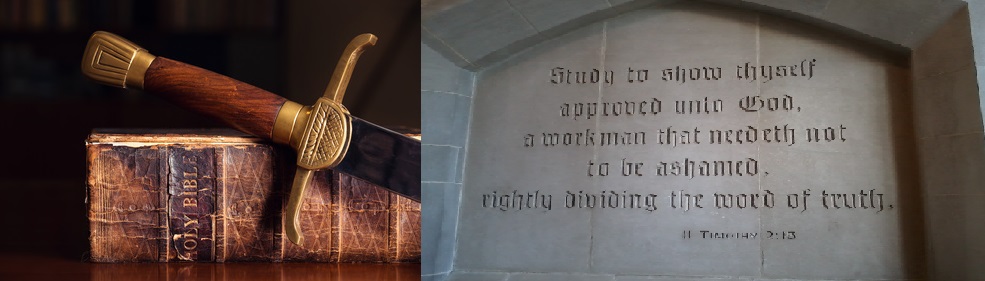
The better way is to believe what you read where you read it. This is where we really need to understand that idea of “rightly dividing the Word of Truth”. While as it is said in 2 Timothy this does carry with it the idea of a workman working according to the plans that his boss — in this case God, the one who he is to show himself approved to — gave him, it also is about the plans that his boss gave him.
We can understand Paul speaking of a heavenly Jerusalem, a Mount Zion that is the city of the living God, Jerusalem that is above with a people who have their citizenship in heaven, who are seated with Christ in the heavenly places even now, without having that undo or change what the Prophets say. Yes, all the promises of God in Christ are “yea and amen” (2 Corinthians 1:20), but it does not undo them. Remember the same apostle’s other words in Romans 15:8—
“Now I say that Jesus Christ was a minister of the circumcision for the truth of God, to confirm the promises made unto the fathers…”
This does not make them void or mean something entirely different than what they say. We should recall that there is the “revelation of the mystery” (Romans 16:25), that does reveal much that was not written in time past but is now revealed. It adds to and fills in blanks that would not be understood otherwise, but it does not undo God’s promises, for the next two verses add “and by the scriptures of the prophets, according to the commandment of the everlasting God…”
The “yea and amen” reveal that God really will be true to His word, not that He has transformed it or absorbed it into something entirely different.
But we also must acknowledge that this heavenly Zion is also real and adds depth that would have never been known beforehand.
“Ye are come” is a true heavenly reality that those who are in Christ have come to even now. We cannot deny that, nor would we want to. That is a blessed reality and it is sometimes too good for words. These that we read in Hebrews 12 are some of the greatest words in Scripture to say where we as believers in Christ — even more we believers who have been baptized into Jesus Christ, made members of His body, of His flesh, and of His bones — reside.
We are not being sent back to the fearful mount, to approach only so close for fear of death, but we are bid to come “boldly to the throne of grace”.
We have with us in heaven an innumerable company of angels. It is to these “principalities and powers in heavenly places” that we reveal the “manifold wisdom of God” (Ephesians 3:10). It is quite amazing to learn that the angels learn from us!
We are come, as it says here, to the general assembly and church of the firstborn, written in heaven. In Ezekiel 46:11, we have the word “solemnities”, which in the Septuagint is the same word as general assemblies in this passage. The worship we have is in heaven, with the angels, in the presence of the God of all. It is the church — the assembling of all together in Christ, who is the firstborn. We are in the presence of God, the judge of all, even now. This is God the judge of all who has rendered the verdict of righteous to those who are in Christ, reconciled to Him by faith in Christ. This is not on the basis of the strength of our faith, but in the all-sufficient redemption that is in His blood, in whom we have the forgiveness of sins according the riches of God’s grace (Ephesians 1:7).
Being written in heaven too is a wonderful thought to have concerning where we have now come. At Sinai God gave His commands to the Israelites written on tablets of stone. Carved in stone is quite permanent. But we have come to the church of the firstborn written in heaven. This is what the Lord said should be the great cause of rejoicing of the seventy that returned to Him after they saw the devils were even subject to them:
“Notwithstanding in this rejoice not, that the spirits are subject unto you; but rather rejoice, because your names are written in heaven” (Luke 10:20).
That is where we are come to as we come to the city of the living God. We are come to the church of the firstborn written in heaven. This is permanent, and more permanent than that which was carved in stone. Being counted among those written in heaven is surely the greatest blessing that we could imagine.
We also are come to another group. This group is called here “the spirits of just men made perfect”. At the end of the previous chapter, we have this concerning the great cloud of witnesses:
“And these all, having obtained a good report through faith, received not the promise: God having provided some better thing for us, that they without us should not be made perfect” (Hebrews 11:39–40).
Those of ages past were not as yet made perfect in their own lifetimes. But in Christ, as redemption is truly accomplished, those of ages past are brought together with us. They were not without us made perfect, but these just men are now with us made perfect. It is in Christ and by Christ that He by one sacrifice perfected forever those that He sanctified. He brought those living under that past covenant into this same fellowship with us brought in by grace into this new covenant. This is the covenant of which Jesus is the mediator. The new covenant is in His blood, and it will later be called the blood of the everlasting covenant (13:20).
Verse 24 ends with this blood being the blood of sprinkling that speaks better things than the blood of Abel.
We meet Abel in Genesis 4 and learn enough about him to know why he was killed by his brother. Of anything else we know very little. But we do learn of his blood crying to God from the ground and in Hebrews 11 we read that “he being dead yet speaketh”. This was his blood unjustly shed crying out to God for vengeance. The cry for vengeance — righteousness finally winning over evil will happen:
“Blessed are they which do hunger and thirst after righteousness: for they shall be filled” (Matthew 5:6).
There will be a time when God will avenge all evil, but the blood of Jesus Christ, sprinkled for purification on all that come to Him is so much better. It brings us into peace with God, gives us God’s righteousness full and free because He was made sin for us (2 Corinthians 5:21). We can know that we have the righteousness applied because we have the witness of Scripture that God did it.
It is the work of God that raised Jesus our Lord from the dead, and it is His work that raises us up in Him. In Colossians 2:12 we have “risen with Him through the faith of the operation of God, who hath raised Him from the dead.” That is what we have in Christ in that new covenant that His blood has put into effect. That is to what we have arrived. We are not directed back to Sinai but to Jesus Christ the Savior. We must take our place with Him and live life here and now knowing that this is the new place of our life. We should not ever let anyone drive us back to Sinai. That is the old way. We are come to better things, those in Jesus Christ, by His all-perfect sacrifice for our sins bringing us to God.
“For by one sacrifice He hath perfected forever them that are sanctified” (Hebrews 10:14).
Categories

Charles Miller View All
Husband, father, engineer...Enjoys fishing, archery, guitar, running, and lifting, but most of all reading and studying God's Word.

